Gardener Barnes — Recycling and Sustainability
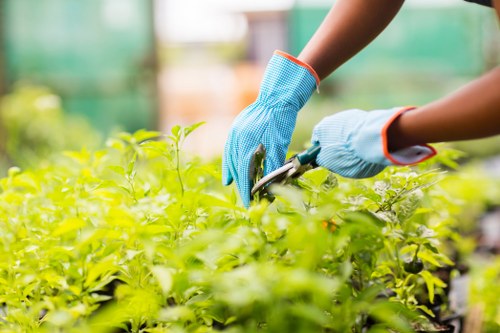 Gardener Barnes is committed to creating an eco-friendly waste disposal area and a thriving sustainable rubbish gardening area across every site we manage. Our aim is practical, measurable and community-focused: we implement on-the-ground operations that reduce landfill, boost reuse and promote circular gardening practices. We believe small operational changes yield big environmental benefits, and we build those changes into daily routines, vehicle choices and partner selection.
Our approach aligns with many boroughs' local schemes for waste separation — typically a three-stream or two-stream system that separates food/green waste, mixed dry recycling and residual rubbish. By adapting to each borough's collection rules we ensure that materials captured on-site flow correctly to municipal recycling and local transfer stations. Proper separation at source not only increases diversion rates but also reduces contamination and the carbon cost of downstream sorting.
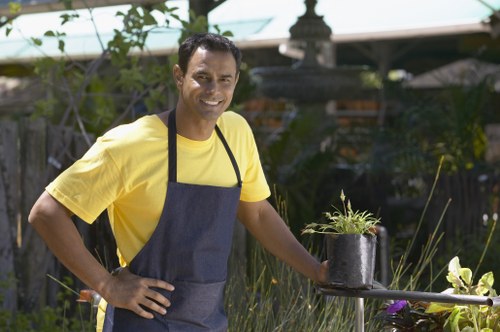 We design each green waste zone to be both a recycling hub and a working garden resource: leaves, prunings and grass cuttings are diverted for composting or chipping; broken pots and clean timber are sorted for reuse or biomass; metals, glass and rigid plastics are set aside for the municipal dry recycling stream. This practical separation is paired with clear labelling, colour-coded bins and staff training so the eco-friendly waste disposal area functions smoothly day-to-day.
Gardener Barnes has set a bold recycling percentage target: we aim to achieve a 70% recycling and reuse rate by 2030 across our managed sites. That target covers both garden-origin waste and associated site materials — soil, timber, pots and packaging. To track progress we run quarterly audits and publish internal performance summaries so teams can see the impacts of route optimisation, on-site separation and our reuse programmes.
We coordinate with local transfer stations and household waste recycling centres to make the network efficient and low-impact. Key elements of this network include:
- scheduled visits to council transfer stations and municipal recycling centres;
- dedicated drop-offs for compostable green waste and wood chips;
- secure drop-off points for scrap metal and bulky horticultural plastics.
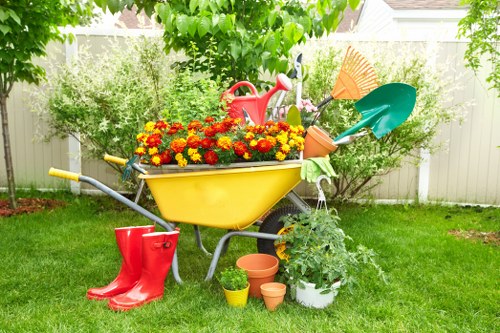 Partnerships with charities and community organisations are central to our reuse strategy. Where plants, pots and furniture are surplus or in good condition we collaborate with local reuse charities, community gardens and social enterprises that host swaps and redistribution events. These partnerships divert usable materials away from the waste stream and support local social value — an approach that complements municipal collections and enhances the sustainable rubbish gardening area we maintain.
Our fleet strategy is designed to lower operational emissions: we prioritise low-carbon vans — electric and plug-in hybrid models where charging infrastructure permits — and specify efficient, load-optimised vehicles for larger transfer runs. Route planning and load consolidation reduce mileage, and we use telematics to monitor idling and fuel efficiency. Moving to a greener fleet is one of the single most effective ways we cut carbon per job.
On-site processing supports a closed-loop gardening model: compost produced from green waste is reused to improve soil structure and reduce the need for peat-based products; wood chippings become mulch and weed suppression; washed aggregate and clean soil are retained for landscaping. These sustainable waste disposal practices lower embodied carbon for new materials and make our horticultural projects demonstrably greener.
Operational practices and community alignment
Our teams adopt borough-level recycling guidance so site separation corresponds with local civic systems. That includes labelling compostable collections where food waste is accepted, keeping glass and rigid plastics with the dry recycling stream when required, and ensuring hazardous items are handled per municipal protocols. We also run staff briefings to keep everyone current with changes in local authority recycling rules.Procurement choices reinforce sustainability: we favour suppliers who offer take-back schemes, recycled-content materials and reusable packaging. When we remove benches, planters or potted plants, items that are repairable or reusable are channelled to charity partners or community projects. A simple reuse pathway reduces landfill and amplifies social value through redistribution.
![A woman with dark hair tied back, wearing a pink and white striped long-sleeve top, is standing in a well-maintained garden during daylight, tending to potted plants with dark soil. The garden features a lush green lawn in the foreground, bordered by various flowering plants and shrubs, some with purple flowers. In the background, there are hedges, a stone wall, and several mature trees that provide dappled sunlight, creating a vibrant and inviting outdoor environment. The surface area appears level with a mix of soil, paving, and garden beds, indicative of a landscaped yard designed for outdoor gardening activities. The image suggests an outdoor space suitable for sustainable gardening practices, with the woman engaging in planting or soil preparation, emphasizing a connection to eco-friendly gardening services offered by Gardener Barnes in the local area around [POSTCODE] or [TOWN], supporting environmentally conscious outdoor maintenance.](/pub/_photos/gardening/f1397686272.jpg) Monitoring and targets are transparent: monthly waste capture reports, contamination rate checks and material-by-material diversion figures help us meet our recycling target. We measure progress not only by tonnage but by the quality of the recycled stream and the number of items reused through charity partnerships. Our aim is a measurable shift from disposal to resource recovery across all sites.
Monitoring and targets are transparent: monthly waste capture reports, contamination rate checks and material-by-material diversion figures help us meet our recycling target. We measure progress not only by tonnage but by the quality of the recycled stream and the number of items reused through charity partnerships. Our aim is a measurable shift from disposal to resource recovery across all sites.
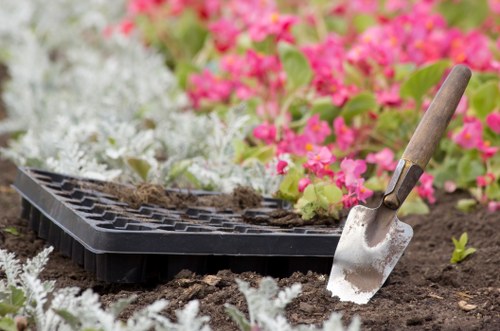 Gardener Barnes invites stakeholders to join our vision for an integrated, low-impact greener future. By combining an effective eco-friendly waste disposal area, a practical sustainable rubbish gardening area, strong charity partnerships and a low-carbon van fleet we deliver both environmental and community benefits. We are committed to continuous improvement — reducing waste, increasing reuse and supporting the boroughs we serve with responsible, scalable practices that make green spaces better for everyone.